Published Scientific Research on 5G, Small Cells Wireless and Health
Published peer reviewed science associating exposure with biological effects already indicates that the current wireless technologies of 2G, 3G and 4G – in use today with our cell phones, computers and wearable tech poses serious risks to humans, animals and the environment. More than 240 scientists published an appeal to the United Nations to reduce public exposure and are calling for a moratorium on 5G citing “established” adverse biological effects of RF radiation.
Companies state that these 4G and 5G antennas will increase the wireless radiation levels in the area so much that they are working to loosen several governments’ radiation limits in order to roll it out.
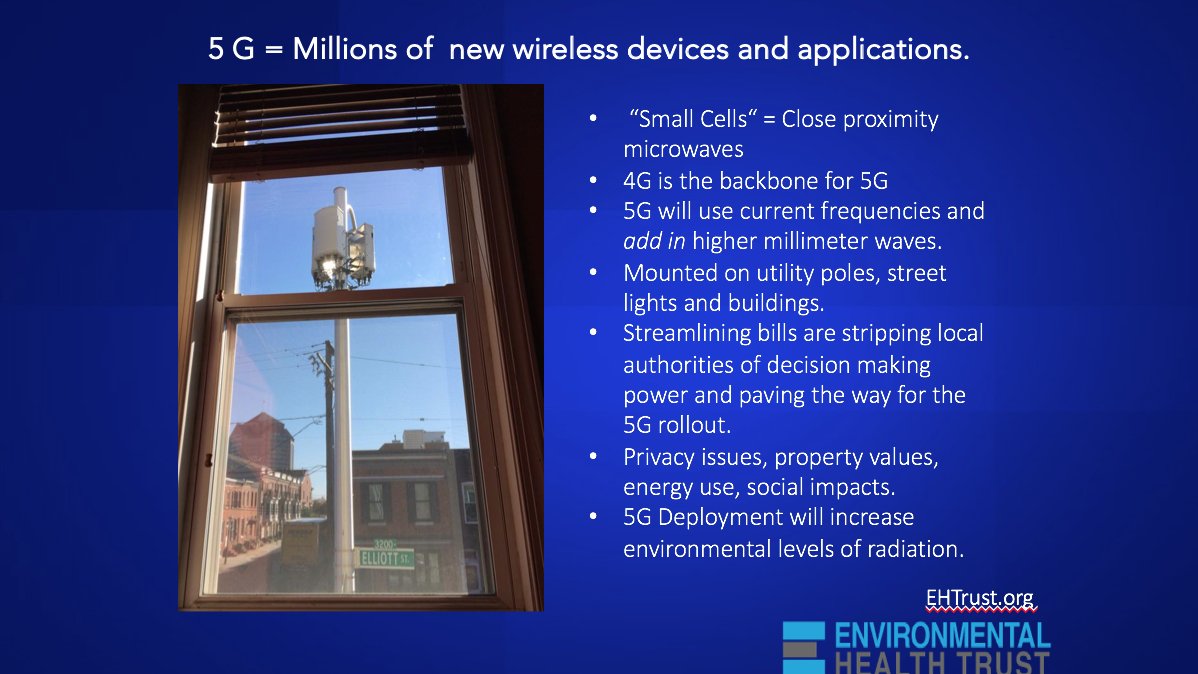
5G will utilize not only the frequencies currently in use, but also higher millimeter wave and sub-millimeter wave frequencies. Small cells (wireless antenna installations) being installed in cities are usually 4G technology with the capacity for 5G installations at a later date. Cell phones and wireless devices in use today and the near future have multiple antennas with a range of frequencies and modulations. Thus, when we consider the health impacts of 5G and “small cells” we need to consider research on current technologies already in use (2G, 3G and 4G) in addition to research on sub-millimeter and millimeter waves. The 5G standard is new and there are no studies that have looked at long term human exposure to 5G specifically.
Published Research Documents Adverse Effects of RF Exposure
Publications on 5G
“5G Wireless Expansion: Public Health and Environmental Implications” is a research review that documents the range of reported adverse effects of RF and millimeter waves—effects range from cancer to bacteria growth changes to DNA damage. The study concludes that “a moratorium on the deployment of 5G is warranted” and “the addition of this added high frequency 5G radiation to an already complex mix of lower frequencies, will contribute to a negative public health outcome … from both physical and mental health perspectives” (Russell 2018).
“Towards 5G communication systems: Are there health implications?” is a research review detailing research findings that millimeter waves can alter gene expression, promote cellular proliferation and synthesis of proteins linked with oxidative stress, inflammatory and metabolic processes.” The researchers conclude, “available findings seem sufficient to demonstrate the existence of biomedical effects, to invoke the precautionary principle” (Di Ciaula 2018).
“Systematic Derivation of Safety Limits for Time-Varying 5G Radiofrequency Exposure Based on Analytical Models and Thermal Dose” documents how significant tissue heating can be generated by 5G technology’s rapid short bursts of energy. “The results also show that the peak-to-average ratio of 1,000 tolerated by the International Council on Non-Ionizing Radiation Protection guidelines may lead to permanent tissue damage after even short exposures, highlighting the importance of revisiting existing exposure guidelines.” (Neufeld and Kuster 2018)
“The Human Skin as a Sub-THz Receiver – Does 5G Pose a Danger to It or Not?” and “The Modeling of the Absorbance of Sub-THz Radiation by Human Skin” are two papers by physicists presenting research that found higher 5G frequencies are intensely absorbed into human sweat ducts (in skin), at much higher absorption levels than other parts of our skin’s tissues (Betzalel 2017, Betzalel 2018). The researchers conclude, “we are raising a warning flag against the unrestricted use of sub-THz technologies for communication, before the possible consequences for public health are explored.”
“Exposure of Insects to Radio-Frequency Electromagnetic Fields from 2 to 120 GHz” published in Scientific Reports is the first study to investigate how insects (including the Western honeybee) absorb the higher frequencies (2 GHz to 120 GHz) to be used in the 4G/5G rollout. The scientific simulations showed increases in absorbed power between 3% to 370% when the insects were exposed to the frequencies. Researchers concluded, “This could lead to changes in insect behaviour, physiology, and morphology over time….” (Thielens 2018)
Review Publications on Electromagnetic Radiation and RF
A 2016 literature review “Oxidative mechanisms of biological activity of low-intensity radiofrequency radiation” found that 93 of the 100 peer-reviewed studies dealing with oxidative effects of low-intensity RFR, confirmed that RFR induces oxidative effects in biological systems.
“Planetary Electromagnetic Pollution: It Is Time to Assess Its Impact” published in The Lancet documents the significant increase in environmental levels of radio-frequency (RF) electromagnetic wireless radiation over the last two decades. The study cites an evaluation that found 68.2% of 2266 studies in humans, animals, and plants demonstrated significant biological or health effects associated with exposure to electromagnetic fields. 89% of experimental studies that investigated oxidative stress endpoints showed significant effects and “radiofrequency electromagnetic radiation causes DNA damage apparently through oxidative stress. The paper also highlights research that has associated RF exposure with altered neurodevelopment and behavioural disorders, structural and functional changes in the brain and the sensitivity of pollinators. “These findings deserve urgent attention.This weight of scientific evidence refutes the prominent claim that the deployment of wireless technologies poses no health risks at the currently permitted non-thermal radiofrequency exposure levels.” (Bandara and Carpenter 2018)
The review “Thermal and non-thermal health effects of low intensity non-ionizing radiation: An international perspective” published by researchers of the European Cancer Environment Research Institute in Brussels, Belgium and the Institute for Health and the Environment, University at Albany, NY, USA reviews current research findings and states that, “the mechanism(s) responsible include induction of reactive oxygen species, gene expression alteration and DNA damage through both epigenetic and genetic processes.” The paper states that “exposure to low frequency and radiofrequency electromagnetic fields at low intensities poses a significant health hazard that has not been adequately addressed by national and international organizations such as the World Health Organization.”
The literature review “Effect of radiofrequency radiation on reproductive health” published by the Division of Reproductive Biology & Maternal Health, Child Health, Indian Council of Medical Research documents research that has found a link between radiofrequency radiation and oxidative stress and changes to the reproductive system including sperm count, motility, normal morphology and viability. The review concludes that the “available data indicate that exposure to EMF can cause adverse health effects. It is also reported that biological effects may occur at very low levels of exposure.”
A 2010 landmark review study on 56 studies that reported biological effects found at very low intensities, including impacts on reproduction, permeability of the blood-brain barrier, behavior, cellular and metabolic changes, and increases in cancer risk (Lai and Levitt 2010).
Cancer
Cancer epidemiology update, following the 2011 IARC evaluation of radiofrequency electromagnetic fields is a comprehensive research review of RF effects in human and animal research. The review concludes that scientific evidence is now adequate to conclude radiofrequency radiation is carcinogenic to humans (Miller 2018). Several previously published studies also concluded that RF can “cause” cancer, for example, Hardell 2017, Atzman 2016 and Peleg 2018.
The US National Toxicology Program (NTP) Study on Cell Phone Radiation found “clear evidence” of cancer, heart damage and DNA damage in a $30-million study designed to test the basis for federal safety limits (NIEHS 2018). The heart and brain cancers found in the NTP rats are the same cell type as tumors that researchers have found to be increased in humans who have used cell phones for over 10 years. Thus, researchers say this animal evidence confirms the human evidence associating the exposure to cancer(Hardell 2019.)
The Ramazzini Institute (RI) Study on Base Station RF was another large scale rat study that also found increases in the same heart cancers that the NTP study found—yet the Ramazzini rats were exposed to much lower levels of RF than the NTP rats. In fact, all the RI Ramazzini radiation exposures were below FCC limits, as the study was specifically designed to test the safety of RF limits for cell tower/base stations (Falconi 2018.) Thus the Ramazzini study corroborates the NTP findings.
Tumor promotion by exposure to radiofrequency electromagnetic fields below exposure limits for humans” is a replication study that used very, very low RF exposures (lower than the Ramazzini and NTP study) and combined the RF with a known carcinogen. Researchers found elevated lymphoma and significantly higher numbers of tumors in the lungs and livers in the animals exposed to both RF and the carcinogen, leading researchers to state that previous research (Tillman 2010) was confirmed and that “our results show that electromagnetic fields obviously enhance the growth of tumors” (Lerchl 2015).
Environment
“A review of the ecological effects of RF-EMF” reviewed 113 studies finding RF-EMF had a significant effect on birds, insects, other vertebrates, other organisms and plants in 70% of the studies (Cucurachi 2013). Development and reproduction in birds and insects were the most strongly affected. As an example of the several studies on wildlife impacts, a study focusing on RF from antennas found increased sperm abnormalities in mice exposed to RF from GSM antennas (Otitoloju 2010).
Studies on bees have found behavioral effects (Kumar 2011, Favre 2011), disrupted navigation Goldsworthy 2009, Sainudeen 2011, Kimmel et al. 2007) decreasing egg laying rate (Sharma and Kumar, 2010) and reduced colony strength (Sharma and Kumar, 2010, Harst et al. 2006).
Research has also found a high level of damage to trees from antenna radiation. For example, a field monitoring study ----spanning 9 years involving over 100 trees (Waldmann-Selsam 2016) found trees sustained more damage on the side of the tree facing the antenna.
5G and the Internet of Things will increase overall use of all types of wireless frequencies.
A published review of effects of Wi-Fi radiation entitled, “Wi-Fi is an important threat to human health” found that “repeated Wi-Fi studies show that Wi-Fi causes oxidative stress, sperm/testicular damage, neuropsychiatric effects including EEG changes, apoptosis, cellular DNA damage, endocrine changes, and calcium overload.
“The Impact of radiofrequency radiation on DNA damage and antioxidants in peripheral blood lymphocytes of humans residing in the vicinity of mobile phone base station” is a research study that compared people living close (within 80 meters) and far (more than 300 meters away) from cellular antennas and found that the people living closer had several significant changes in their blood predictive of cancer development (Zothansiama 2017). An earlier 2016 study looking at 116 persons exposed to radiation from mobile towers and 106 control subjects found DNA damage in peripheral blood lymphocytes (Gulati 2016).
“Mortality by neoplasia and cellular telephone base stations” is a 10 year study by the Belo Horizonte Brazil Health Department and several universities in Brazil that found an elevated relative risk of cancer mortality at residential distances of 500 meters or less from cell installations (Dode 2011). Shortly after this study was published, the city prosecutor sued several cell phone companies and requested that almost half of the city’s antennas be removed. Many antennas were dismantled.
A 2019 study of students in schools near cell towers found their higher RF exposure was associated with impacts on motor skills, memory and attention (Meo 2019). Examples of other effects linked to cell towers in research studies include neuropsychiatric problems, elevated diabetes, headaches, sleep problems and genetic damage.
A published study entitled, “Effect of Mobile Tower Radiation on Microbial Diversity in Soil and Antibiotic Resistance” took soil samples from four different base stations located in Dausa city, and control samples from soil far from stations and then isolated and evaluated the microorganisms in the soil. The researchers found greater antibiotic resistance in microbes present in soil near base stations compared to the control. The study concludes, “our findings suggest that mobile tower radiation can significantly alter the vital systems in microbes and turn them multidrug resistant (MDR) which is most important current threat to public health.”
Research on 3G and 4G
3G and 4G technology is still very much in use around the world. In addition, 5G devices will also have 4G emissions and 5G will use the frequencies currently used in 2G, 3G and 4G.
A 2019 study on human blood found microwave 3G MT EMF/radiation - within the current exposure limits - had significant genotoxic action on human cells (Panagopoulos 2019). A series of landmark papers found that effects from microwaves on human lymphocytes can be dependant on carrier frequency (Belyaev 2005), that UMTS (3G) microwaves can affect chromatin and inhibit formation of DNA double-strand breaks (Belyaev 2009) and that stem cells are most sensitive to microwave exposure (Belyaev 2010). Children have more active stem cells.
4G or the fourth generation of cellular technology called Long Term Evolution or LTE was launched without premarket safety testing for long term exposure. Published research has found behavioral changes in mice (Broom 2019); damage to the testes and reproductive potential in mice (Yu 2019); reduction to EEG alpha power (Vecsei 2018); modulation to resting state EEG on alpha and beta bands (Yang 2017); alteration of spontaneous low frequency fluctuations induced by the acute LTE RF-EMF exposure (Lv 2014).
“Compared with sham-exposed controls, exposure at 0.5 W/kg significantly decreased drinking frequency (P ≤ 0.000) and significantly decreased distance moved (P ≤ 0.001). In contrast, exposure at 1 W/kg significantly increased drinking frequency (P ≤ 0.001) and significantly increased moving duration (P ≤ 0.005). In the absence of other plausible explanations, it is concluded that repeated exposure to low-level RF fields in early life may have a persistent and long-term effect on adult behavior.” Broom 2019
A 2018 double‐blind, crossover, randomized, and counterbalanced design study Modulation of brain functional connectivity by exposure to LTE (4G) cell phone radiation found that acute LTE‐EMF exposure did modulate connectivity in some brain regions and the authors conclude that "Our results may indicate that approaches relying on network‐level inferences can provide deeper insights into the acute effects of LTE‐EMF exposure with intensities below the current safety limits on human functional connectivity. In the future, we need to investigate the evolution of the effect over time.” (Wei 2018).
The Building Industry
The paper “Building science and radiofrequency radiation: What makes smart and healthy buildings” with a long list of authors including former Microsoft Canada President Frank Clegg as well as Anthony Miller MD former Director of the Epidemiology Unit of the National Cancer Institute of Canada reviews research finding adverse health effects below regulatory limits and recommends reducing radiofrequency radiation in buildings by installing wired rather than wired internet connections and corded rather than cordless phones (Clegg 2019).
The Collaborative for High Performance Schools has developed Best Practices for LOW EMF classrooms that details how schools can replace wireless networks with wired networks. See CHPS Low EMF Criteria
Cell Towers and Health
A 2014 publication in Environmental Science & Policy by human rights experts argue that cell tower placement is a human rights issue for children because “the protection of children is a high threshold norm in Human Right law and the binding language of the Convention on the Rights of the Child obliges States Parties to provide a higher standard of protection for children than adults” and “any widespread or systematic form of environmental pollution that poses a long-term threat to a child’s rights to life, development or health may constitute an international human rights violation.” The article concludes that the “dearth of legislation to regulate the installation of base stations (cell towers) in close proximity to children's facilities and schools clearly constitutes a human rights concern…” (Roda and Perry 2014).
"Safety Zone Determination for Wireless Cellular Tower - A Case Study from Tanzania” published in the International Journal of Research in Engineering and Technology evaluated the radiation levels and concluded that "respective authorities should ensure that people reside far from the tower by 120m or more depending on the power transmitted to avoid severe health effect."
“Long-term exposure to microwave radiation provokes cancer growth: evidences from radars and mobile communication systems” published in Experimental Oncology reviews research findings on RF-EMF and states that it is “becoming increasingly evident that assessment of biological effects of non-ionizing radiation based on physical (thermal) approach used in recommendations of current regulatory bodies, including the International Commission on Non-Ionizing Radiation Protection (ICNIRP) Guidelines, requires urgent reevaluation.” The paper concluded that “everyday exposure of both occupational and general public to MW radiation should be regulated based on a precautionary principles which imply maximum restriction of excessive exposure” (Yakymenko 2011)
A cross-sectional case control study on genetic damage in individuals living near cell towers found genetic damage parameters of DNA were significantly elevated (Gandhi 2015).
“Neurobehavioral effects among inhabitants around mobile phone base stations” published in Neurotoxicology concluded that “Inhabitants living nearby mobile phone base stations are at risk for developing neuropsychiatric problems and some changes in the performance of neurobehavioral functions either by facilitation or inhibition” and called for the revision of standard guidelines for public exposure to RER from mobile phone base station antennas” (Abdel-Rassoul, 2006).
“Epidemiological Evidence for a Health Risk from Mobile Phone Base Stations” published in the International Journal of Occupational Environmental Health reviewed 10 epidemiological studies that assessed for health effects of mobile phone base stations and found that eight of the 10 studies reported increased prevalence of adverse neurobehavioral symptoms or cancer in populations living at distances < 500 meters from base stations. The review concludes that” current guidelines may be inadequate in protecting the health of human populations” (Khurana 2010).
“How does long term exposure to base stations and mobile phones affect human hormone profiles?” published in Clinical Biochemistry followed volunteers for six years and found that high radio frequency radiation had effects on pituitary–adrenal axis represented in the reduction of ACTH, cortisol, thyroid hormones, prolactin in young females, and testosterone levels (Eskander 2012).
A study of 530 people living near mobile phone masts reported more symptoms of headache, sleep disturbance, discomfort, irritability, depression, memory loss and concentration problems the closer they lived to the cellular antennas (Santini 2002).
A study from Spain “The Microwave Syndrome: A preliminary Study” published in Electromagnetic Biology and Medicine found statistically significant associations between field intensity and the symptoms of fatigue, irritability, headaches, nausea, loss of appetite, sleeping disorder, depressive tendency, feeling of discomfort, difficulty in concentration, loss of memory, visual disorder, dizziness and cardiovascular problems (Navarro 2003). “Subjective symptoms, sleeping problems, and cognitive performance in subjects living near mobile phone base stations.” published in Occupational Environmental Medicine found a significant correlation between measured power density and headaches, fatigue, and difficulty in concentration in 365 subject (Hutter 2006). Abdel-Rassoul 2007 found residents living beneath and opposite a long established mobile phone mast reported significantly higher occurrences of headaches, memory changes, dizziness, tremors, depressive symptoms and sleep disturbance than a control group.
“Increased Incidence of Cancer Near a Cell-Phone Transmitter Station” published in the International Journal of Cancer Prevention found a four-fold increase in the incidence of cancer among residents living within 300m radius of a mobile phone mast after three and seven years of exposure (Wolf 2004).
“The Influence of Being Physically Near to a Cell Phone Transmission Mast on the Incidence of Cancer” found a three-fold increase in the incidence of malignant tumours after five years’ exposure in people living within 400m radius of a mobile phone mast (Eger 2004).
Cell Antennas Increase Exposures in Communities
A 2019 study found increased RF-EMF exposure from small cell LTE networks in two urban cities in France and the Netherlands. Researchers measured the RF-EMF from LTE (Long-Term Evolution) MC (macro cells meaning large cell towers) and SC networks (low-powered small cell base stations) and found that the small cell networks increased the radio emissions from base stations (called downlink) a factor of 7–46 while decreasing the radio emissions from user equipment exposure (called ) a factor of 5–17. So while the devices themselves could emit less radiation, the cell antennas will increase the levels from cell antennas (Mazloum 2019). This study shows the increased exposures would be involuntary. We can turn our phone off, but we cannot turn off the antennas in the neighborhood.
An Australian study also found that children in kindergartens with nearby antenna installations had nearly three-and-a-half times higher RF exposures than children with installations further away (more than 300 meters (Bhatt 2016).
A 2018 multi-country study that measured RF in several countries found that cell phone tower radiation is the dominant contributor to RF exposure in most outdoor areas exposure in urban areas was higher and that exposure has drastically increased. As an example, the measurements the researchers took in Los Angeles, USA were 70 times higher than the US EPA estimate 40 years ago (Sagar 2018).
As an example of how rapidly RF is increasing from wireless antennas, a 2014 published study looked at RF in three European cities and found in just one year (between April 2011 and March 2012) that the total RF-EMF exposure levels in all outdoor areas in combination increased by 57.1% in Basel by 20.1% in Ghent and by 38.2% in Brussels (Urbinello 2014). “Exposure increase was most consistently observed in outdoor areas due to emissions from mobile phone base stations.”
Another study, Birks 2018, looked at 529 children in Denmark, the Netherlands, Slovenia, Switzerland and Spain who wore meters around the waist or carried in a backpack during the day and placed close to the bed at night. Researchers found “the largest contributors to total personal environmental RF-EMF exposure were downlink (meaning from cell tower base stations) and broadcast.”
Cell tower radiation is a significant contribution to our daily dose of RF. A study on Australian adults where participants carried a measuring device in a small hip bag for approximately 24 consecutive hours also found “downlink and broadcast are the main contributors to total RF-EMF personal exposure.” Downlink (RF from mobile phone base station) contributed 40.4% of the total RF-EMF exposure (Zeleke 2018). Another published study (Choi 2018) that gave 50 Korean adult child pairs a special radiation measuring device for 48 hours evaluated the types of radiation the participants were exposed to and found that “the contribution of base-station exposure to total RF-EMF exposure was the highest both in parents and children.”
The Bioeffects of Millimeter Waves Documented Years Ago
A Russian Review on Millimeter Waves declassified by the CIA in 2015 “Biological Effect of Millimeter Waves” reported multiple research findings and concluded that “Morphological, functional and biochemical studies conducted in humans and animals revealed that millimeter wave caused changes in the body manifested in structural alterations in the skin and internal organs, qualitative and quantitative changes of the blood and bone marrow composition and changes of the conditioned reflex activity, tissue respiration, activity of enzymes participating in the process of tissue respiration and nucleic metabolism.” (Zalyubovskaya)
“Current state and implications of research on biological effects of millimeter waves: a review of the literature” published in Bioelectromagnetics reviewed dozens of research findings on low-intensity millimeter waves and concluded that the reported “MMW effects could not be readily explained by temperature changes during irradiation.” The review concludes by questioning the adequacy of regulatory limits stating that, “Safety limits for these types of exposure are based solely on predictions of energy deposition and MMW heating, but in view of recent studies this approach is not necessarily adequate.” (Pakhomov )
Additional Research
Panagopoulos, D. J., Johansson, O., & Carlo, G. L. (2015). Polarization: A Key Difference between Man-made and Natural Electromagnetic Fields, in regard to Biological Activity. Scientific reports, 5, 14914. doi:10.1038/srep14914
Panagopoulos, D. J., Johansson, O., & Carlo, G. L. (2015). Real versus Simulated Mobile Phone Exposures in Experimental Studies. BioMed research international, 2015, 607053. doi:10.1155/2015/607053
Hardell, L., & Carlberg, M. (2018). Comments on the US National Toxicology Program technical reports on toxicology and carcinogenesis study in rats exposed to whole-body radiofrequency radiation at 900 MHz and in mice exposed to whole-body radiofrequency radiation at 1,900 MHz. International journal of oncology, 54(1), 111–127. doi:10.3892/ijo.2018.4606
Michael Carlberg and Lennart Hardell, “Evaluation of Mobile Phone and Cordless Phone Use and Glioma Risk Using the Bradford Hill Viewpoints from 1965 on Association or Causation,” BioMed Research International, vol. 2017, Article ID 9218486, 17 pages, 2017. https://doi.org/10.1155/2017/9218486.
Coureau, Gaëlle, et al. "Mobile phone use and brain tumours in the CERENAT case-control study." Occupational and Environmental Medicine, vol. 71, no. 7, 2014, pp. 514-22.
Volkow, Nora D., et al. "Effects of cell phone radiofrequency signal exposure on brain glucose metabolism."JAMA, vol. 305, no. 8, 2011, pp. 808-13.
Kostoff, Ronald N., and Clifford GY Lau."Combined biological and health effects of electromagnetic fields and other agents in the published literature."Technological Forecasting and Social Changevol. 80, no. 7, 2013, no. 1331-49.
Pall, M. Electromagnetic fields act via activation of voltage-gated calcium channels to produce beneficial or adverse effects. Journal of Cellular and Molecular Medicine, vol. 17, no. 8, 2013 pp. 958-965
Markovà, Eva, Lars OG Malmgren, and Igor Y. Belyaev. "Microwaves from mobile phones inhibit 53BP1 focus formation in human stem cells more strongly than in differentiated cells: possible mechanistic link to cancer risk."Environ Health Perspect, vol. 118, no. 3, 2010, pp. 394-9.
Asl JF, Larijani B, Zakerkish M, Rahim F, Shirbandi K, Akbari R. The possible global hazard of cell phone radiation on thyroid cells and hormones: a systematic review of evidence. Environ Sci Pollut Res Int. 2019 May 6. doi: 10.1007/s11356-019-05096-z.
Adams, Jessica A., et al.“Effect of mobile telephones on sperm quality: A systematic review and meta-analysis.”Environmental International, vol. 70, 2014, pp. 106-12.
Avendano, Conrado, et al. "Use of laptop computers connected to internet through Wi-Fi decreases human sperm motility and increases sperm DNA fragmentation."Fertility and Sterility, vol. 97, no. 1, 2012, pp. 39-45.
Houston, B.J., et al. “The effects of radiofrequency electromagnetic radiation on sperm function.”Reproduction, vol. 152, no. 2, 2016, pp. R263-76.
This is just a short sampling of research studies finding adverse effects. For more please see etrust.org and the abstracts and research summaries on the Bioinitiative site.